
Long distance inductive proximity sensors offer 2-4 times standard range, ideal for heavy manufacturing, automotive, robotics. This guide covers extended range tech, key differences, and selection.
In the rapidly changing field of industrial automation, standard sensors are often difficult to meet demand. When it is necessary to detect metal objects and don’t want to bear the risk of collision or high temperature damage, it is appropriate to choose a long distance inductive proximity sensor. They have a standard sensor sensing range of 2 to 4 times the distance, making them an indispensable tool in the fields of heavy manufacturing, automotive assembly and robotics.
This guide will answer the question you are most concerned about: how do they achieve ultra long sensing distances? What is the difference between it and the standard normal sensors? And how to choose the right product for your specific application?
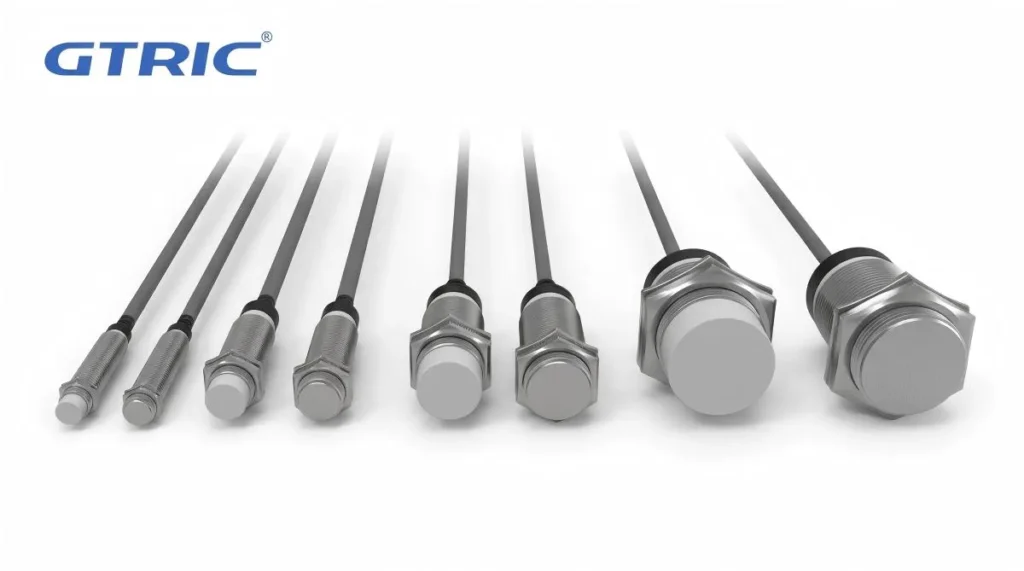
What are Long Distance Inductive Proximity Sensors?
Long distance inductive proximity sensor is an industrial sensor that can detect metal objects without contact. Compared with standard inductive sensors, its biggest feature is that it has a detection distance of up to 2 times or more.
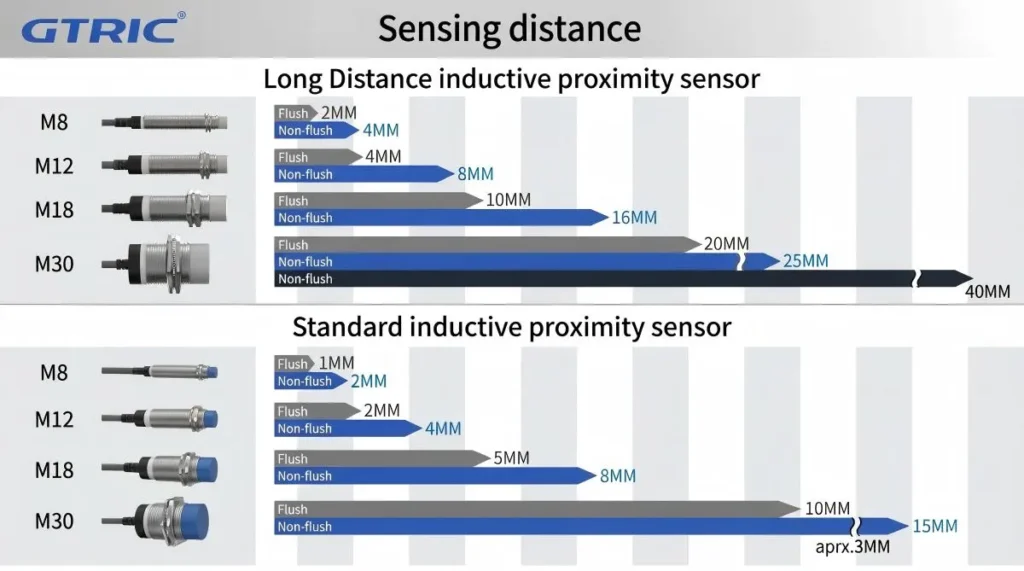
Standard inductive sensors typically operate within a limited range of the target (usually between 2mm and 15mm) to trigger a signal. However, long distance inductive proximity sensors use electromagnetic fields to detect metals such as steel, aluminum, and copper. The extension of the detection distance (such as 20mm, 40mm or even further) is achieved through optimized coil design and high-performance oscillators.
These oscillators project a stronger magnetic field, which allows long distance inductive proximity sensors to be mounted farther away from moving targets. So as to protect the sensor’s sensing surface from physical impact, high temperature and vibration.
In simple terms:
What is the role of long-distance inductive proximity sensors?
The answer is that it is mainly used to detect metal objects in non-contact situations, especially when the installation space is limited or when it is necessary to prevent the sensor from colliding with the moving object, its extended detection distance can effectively avoid damage to other facilities.
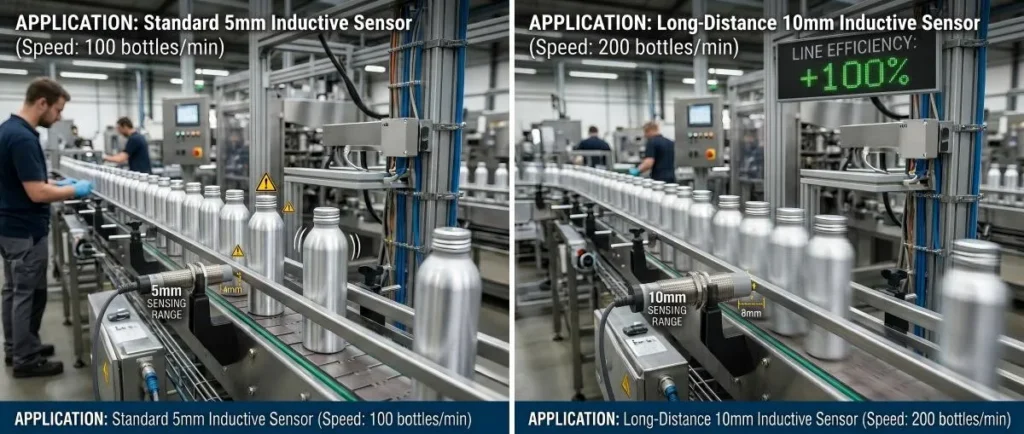
Long Distance Inductive Proximity Sensor Vs. Standard Sensor
To make you know the difference between the two more intuitively, we have compiled the following comparison tables, which helps engineers quickly capture core data:
| Comparison table of standard inductive sensor and long distance inductive sensor | ||
|---|---|---|
| Feature | Standard Inductive Sensor | Long Distance Inductive Proximity Sensor |
| Sensing Range | 1x (Standard, e.g., 2mm-4mm) | 2x to 4x (Extended, e.g., 8mm-40mm) |
| Sensitivity | Lower | Higher sensitivity to magnetic flux changes |
| Mounting | Often Flush (Shielded) | Often Non-Flush (Unshielded) for max range |
| Risk of Collision | High (Target must be very close) | Low (Target can be further away) |
| Cost | Lower | Moderate to High |
5 Core Advantages: Why Upgrading is the Wise Choice
The use of long distance inductive proximity sensors is for long sensing distance, besides also for the overall stability of the system. The following are the five core advantages it brings:
- Significantly reduce the risk of damage
This is the most direct benefit. Because long-distance inductive proximity sensors can be mounted farther away from moving metal parts (e.g. from 10mm to 30mm), it doesn’t directly impact the sensor surface even if the target object is mechanically loosened or deviates from the orbit. This greatly prolongs the service life of the sensor.
- Improve the system running time
By reducing sensor damage and false triggering, long distance inductive proximity sensors ensure continuous operation of the production line. For high-output industries such as automobile manufacturing and stamping workshops, even if one hour of downtime is reduced, the money saved is enough to cover the cost of sensor upgrades.
- Higher installation tolerance
When designing mechanical structures, engineers often cannot guarantee millimeter-level installation accuracy. Long-distance sensors provide greater operating space. This means that in the installation and commissioning phase, technicians do not need to spend a lot of time to fine-tune the position of the sensor.
- Powerful penetration detection capability
Due to the stronger magnetic field, such sensors can sometimes penetrate non-metallic materials (such as Teflon protective cover, glass or plastic wall) to detect the metal behind. This is very useful in the food processing or chemical industry because the sensor can be sealed behind a protective layer to avoid corrosion.
- Adapting to harsh environment
In order to support long distance detection, such sensors usually use stronger shell materials and the full potting process to make them have a higher waterproof and dust-proof grade (like IP67 to IP69K).
How to Choose the Appropriate Long Distance Inductive Proximity Sensors?
When purchasing a long distance inductive proximity sensor, be sure to consider the following elements:
1. Determine the actual required induction distance
The core advantage of a long distance inductive proximity sensor is the wide detection range (usually 2-4 times the standard), but you must distinguish the rated distance from the actual effective distance.
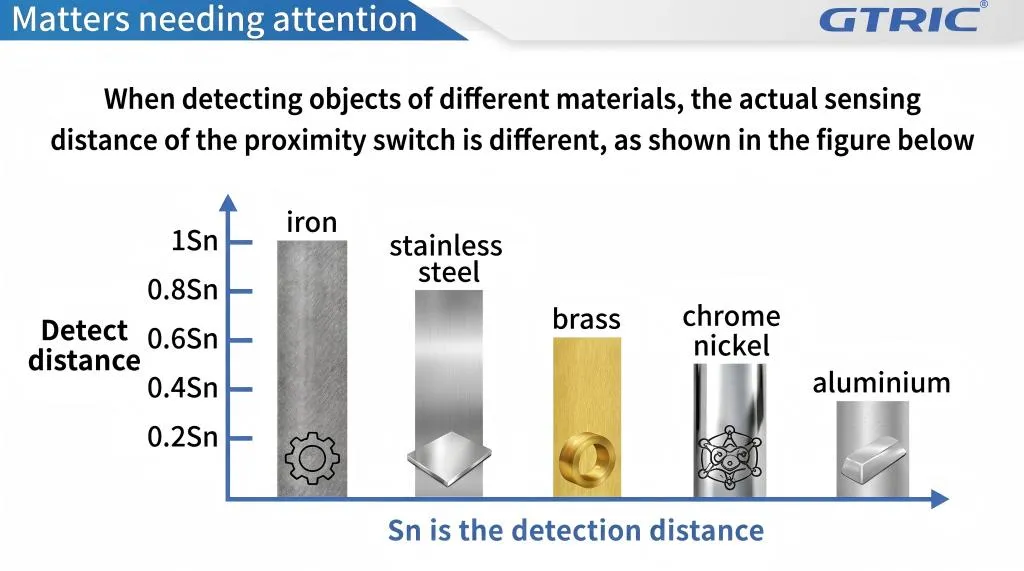
2. Evaluate the material of the object.
3. Evaluate if the installation is suitable (flush vs. non-flush)
- Flush: It can be embedded in a metal base, usually with a short detection distance, but has strong anti-interference ability.
- Non-Flush: The sensor head must be exposed to the metal seat, usually providing the longest detection distance, but attention should be paid to the interference of the surrounding metal.
4. Electrical output type (PNP vs. NPN)
This step depends on your control system-PLC interface:
- NPN is mostly used by Japanese brands PLC (such as Mitsubishi, Omron).
- PNP is commonly used by European and American brands PLC (such as Siemens, Schneider).
- Normally open (NO) vs.normally closed (NC): Most automation applications use NO, where the signal is present only when an object is detected.
5. Check environmental factors
In general working conditions, it is recommended to use products with a protection level of IP67. In the case of high-pressure water washing (such as the food industry), the model with a protection level of IP69K should be selected. If the equipment is used near the welding robot, a special model with strong magnetic field resistance must be selected. Such products usually have a Teflon coating to prevent slag adhesion and ensure stable operation under strong magnetic field interference.
Recommended application fields
- Automobile manufacturing
In welding units and assembly lines, parts move quickly and the position may change slightly. The long distance inductive proximity sensor can reliably detect the vehicle chassis frame without worrying that the sensor is damaged by the mechanical arm or the part itself.
- Conveying system
Used to detect the tray or metal box on the conveyor belt. The extended sensing range allows the sensor to be safely mounted under or on the side of the track to prevent it from being hit or stuck by falling debris.
- High temperature environment
By installing the sensor farther away from the thermal target (such as the steel plate of the foundry), the sensor receives less radiant heat, thereby significantly extending its service life.
Does the accuracy of the long distance inductive proximity sensor decrease as the distance increases?
Usually not. The high quality long distance inductive proximity sensor has high repeatability accuracy within the rated range. However, as the distance approaches the limit range, the hysteresis effect of the switching point may increase slightly.
Can this sensor detect plastic?
No. Long-distance inductive proximity sensors are specifically used to detect metals. If you need to detect plastics or liquids over long distances, it is recommended to use capacitive proximity sensors or photoelectric sensors.
Can the long distance inductive proximity sensor detect non-ferrous metals such as aluminum or copper?
It can be detected, but the detection distance will be greatly attenuated.
Common long-distance type: When detecting aluminum/copper, the distance is about 30 % ~40 % of the nominal distance. All metal coefficient type 1: If the application needs to maintain long distance detection of non-ferrous metals. It is recommended to select a special model of ‘Factor 1’, which has basically the same detection distance for iron and aluminum.
Is the switching frequency (response speed) of the long distance inductive proximity sensor lower than that of the standard type?
Usually yes. In order to obtain a longer detection distance, the Q value of the oscillating circuit inside the sensor is usually higher, and the time of energy accumulation and release is longer. Therefore, the ‘switching frequency-Hz’ of the long-distance type is often lower than that of the standard type of the same size.
Conclusion
In the pursuit of efficient and intelligent Industry 4.0 era, upgrading to long distance inductive proximity sensors is usually the preferred choice to improve automated production lines. By understanding the physical principles of the electromagnetic field, complying with the area requirements for non-flush mounting, and considering the metal attenuation coefficient, you can eliminate false triggering and avoid costly collision damage.
Long distance inductive proximity sensors have become a key component to improve the level of factory automation by providing larger physical gaps, stronger durability, and smarter connectivity. If you’re experiencing frequent sensor damage or unstable detection, try upgrading to a longer-range model. This is not only the upgrading of hardware, but also a powerful investment in production efficiency.
Want to know more about industrial sensors? Please see our: