
Analog output inductive proximity sensors detect metal targets and provide precise location data. Gtric technology explains its working principle to application, aiding sensor selection for system upgrades.
In the field of rapid development of industrial automation, accuracy usually affects the final results. The standard sensor can only detect whether the object exists, and the analog output inductive proximity sensor has raised the intelligence to a new level. Besides it can detect whether the metal target exists, and also accurately inform the specific location of the target.
If you’re planning to upgrade your automation system to get accurate location responses, it’s important to have profound knowledge and control of the technology. Gtric technology will explain the whole content of the analog output inductive proximity sensor from the working principle to the practical application. It’s hoped that this will help engineers and technicians to make appropriate selection decisions.
What is An Analog Output Inductive Proximity Sensor?
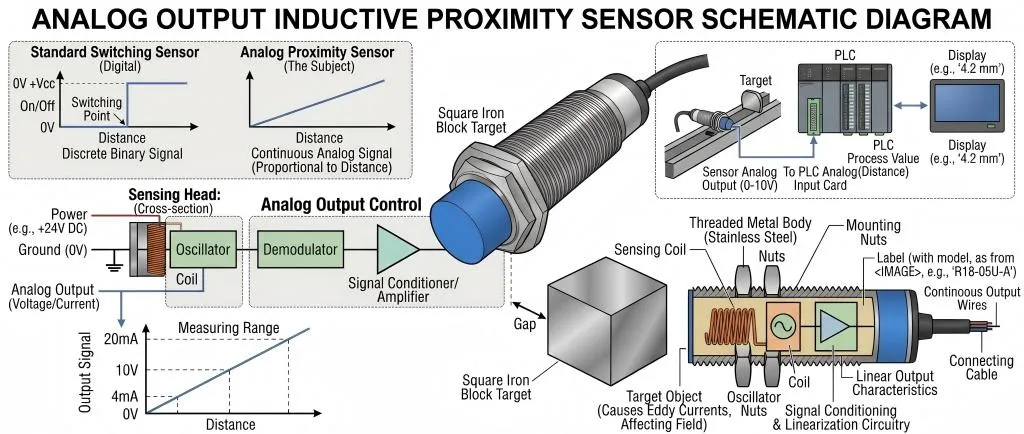
The analog output inductive proximity sensor is used for non-contact measurement of the distance of a metal object relative to the sensor’s induction surface. It is different from the standard switch digital output sensor that provides a binary (on/off) signal. An analog sensor outputs continuous signals – usually voltage (0-10V) or current (4-20mA) output proportional to the distance from the target object.
Under What Cases Would You Choose It?
The standard sensors are ideal for counting, but they are powerless when you need to monitor the following:
- Continuous motion monitoring
- Material thickness measurement
- Eccentricity or vibration analysis
- Precision fixture positioning
By converting the physical distance into electrical values, these sensors allow programmable logic controllers (PLCs) to make complex decisions based on accurate measurement data. Technicians in the industry often identify such sensors as ‘measurement’ devices, rather than simply’detection’devices, because they have the ability to provide linear feedback.
The Working Principle of Analog Output Inductive Proximity Sensor
To master the use of this analog output inductive proximity sensor, we must understand the physical principles behind it:
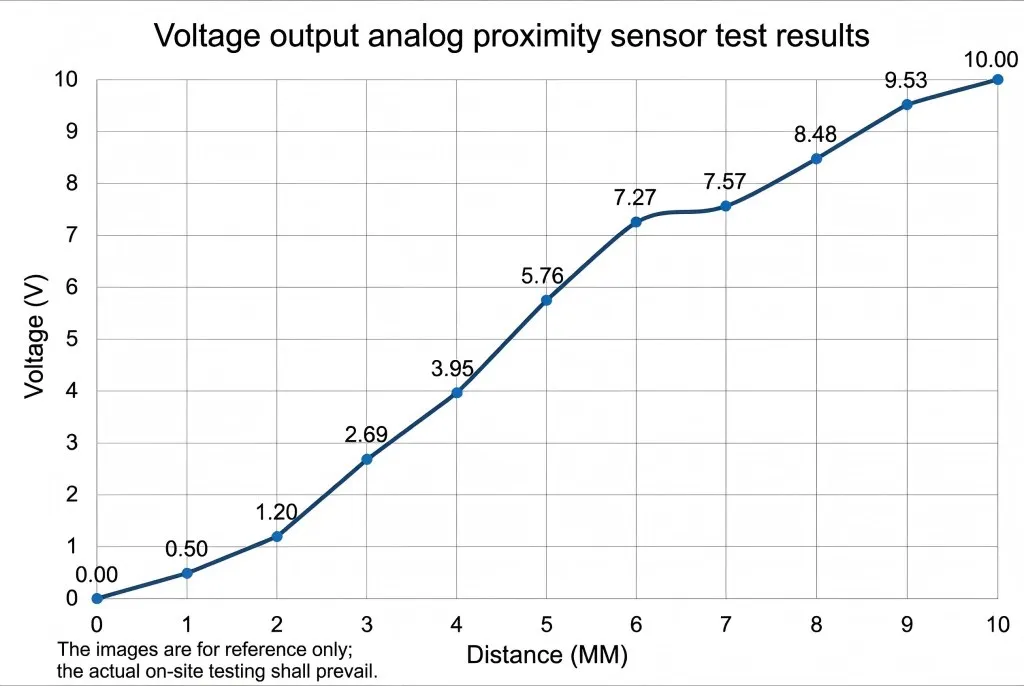
When the coil inside the sensor generates high-frequency electromagnetic fields, once metal targets enter the magnetic field, eddy current will be induced on its surface. These eddy currents consume the energy of the oscillator, and the analog inductive sensor continuously measures this change in energy loss through the internal circuit and converts it linearly into an analog output signal. In this way, as the distance between the metal target and the sensor changes, the output voltage will increase or decrease linearly accordingly.
Analog Output Inductive Proximity Sensor vs. Switch Sensor
| Comparison table of analog output sensor and switching sensor | ||
|---|---|---|
| Feature | Switching Sensor (Digital Output) | Analog Output Sensor |
| Output Type | Binary (On/Off) | Continuous (0-10V, 4-20mA) |
| Function | Detection/Counting | Measurement/Positioning |
| Cost | Low | Moderate to High |
| Complexity | Simple logic | Requires Analog Input Module on PLC |
| Response | Immediate trigger | Real-time distance data |
Understand the Output Signal: Voltage vs. Current
When selecting an analog output inductive proximity sensor, two main interface types are usually encountered. According to the specific control system architecture and electrical environment conditions, it is the key to select the appropriate type.
1. Voltage Output (0-10 V)
Working principle: The output voltage changes linearly with distance.
The significant advantage of this output method is that the measurement is simple, and the normal multimeter can be used to complete the troubleshooting and verification. However, its signal is susceptible to line resistance, which will cause voltage drop when transmitted over long-distance cables, and is sensitive to electromagnetic interference. Therefore, the best application scenario of this kind of sensor is the industrial field with short distance transmission and relatively clean electromagnetic environment.
2. Current output (4-20 mA)
Working principle: The analog output inductive proximity sensor adjusts the current flow, and the signal transmission is not affected by the voltage caused by the resistance (within a certain limit).
This output mode has strong anti-electromagnetic interference ability; in addition, since the current will not drop to 0 mA during normal operation, the disconnection fault alarm can be realized by detecting the 0 mA state. Although this signal type is slightly inconvenient when it needs to be serialized into the loop for measurement, its excellent anti-noise performance makes it particularly suitable for long-distance wiring and harsh environments.
3. Comprehensive output (0-10V, 4-20mA)
The Gtric Analog Output Inductive Proximity Sensor has both voltage and current output channels, which can flexibly meet various application requirements. Users can choose to use one of them according to the interface requirements of subsequent devices. The tail potentiometer is designed to allow users to easily adjust the output voltage or current at different detection distances, ensuring optimal performance and adaptability in real-time operating scenarios.
Key Specification Parameters for Selection
There are significant differences in performance and accuracy between different types of measurement sensors. Therefore, when reviewing the product data manual, it is recommended to focus on the following three core parameters:
- Linearity: Indicates the flatness of the output curve. The measurement range of low linear error can ensure that the PLC receives accurate distance data.
- Resolution: refers to the minimum distance change that the analog output inductive proximity sensor can detect.
- Repeatability: If the target is close to the sensor 100 times, whether the sensor can provide repeatable readings for 100 consecutive detections is the core criterion for evaluating its performance.
Common Applications in Industry
- Material selection and sorting
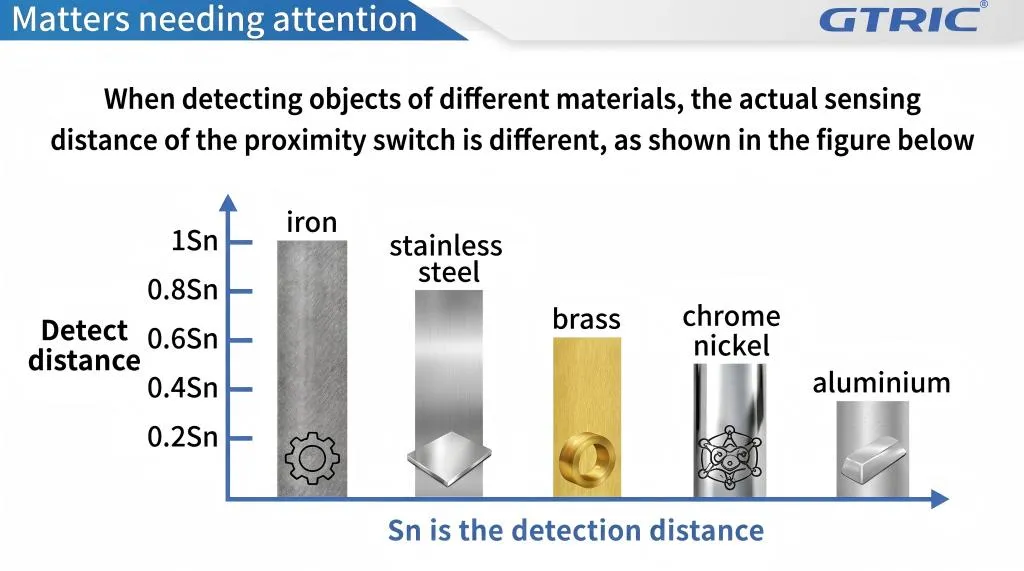
By detecting the distance (or attenuation change based on metal type), analog output inductive proximity sensors can distinguish between different metals, or verify whether the component has been fully installed in the fixture.
- Eccentricity and vibration monitoring
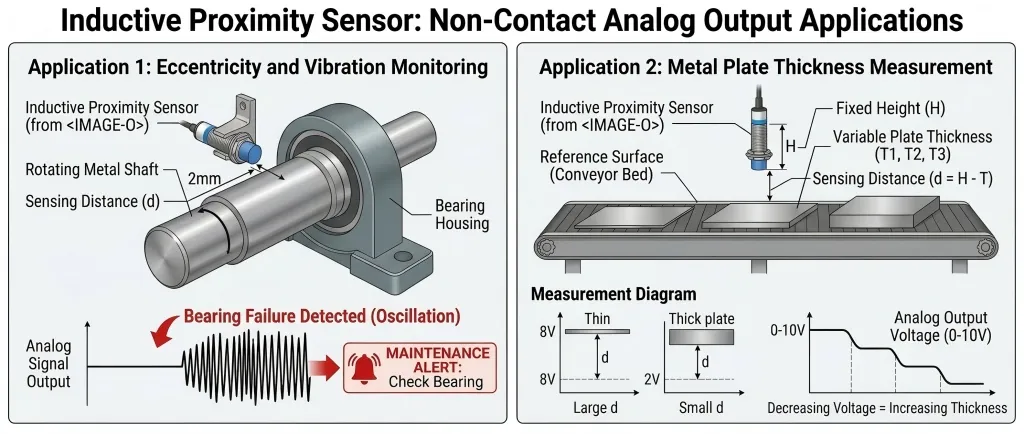
In rotating machinery, an analog sensor placed near the shaft can monitor ‘run-out’ or vibration. If the shaft starts to swing, the analog signal will also oscillate, thereby reminding the maintenance team of possible bearing failures.
- Metal plate thickness measurement
The sensor is placed above the metal plate (the metal plate is placed on the reference surface), and the sensor measures the distance from it to the top of the plate. As the plate becomes thicker and the distance decreases, the analog signal changes.
The analog output inductive proximity sensor fills the gap between simple detection and complex measurement systems. By providing real-time, linear data on the location of metal objects, it enables engineers to build smarter, more responsive automation products. Whether you are measuring the eccentricity of the drive shaft, or ensuring the precision alignment of the manipulator, the transition from discrete sensing to analog sensing marks an important upgrade in the sensing capability of the automation system.
If you want to know how to install the tutorial, please read the following blog:
Analog Output Inductive Proximity Sensor Installation and Wiring Guide